



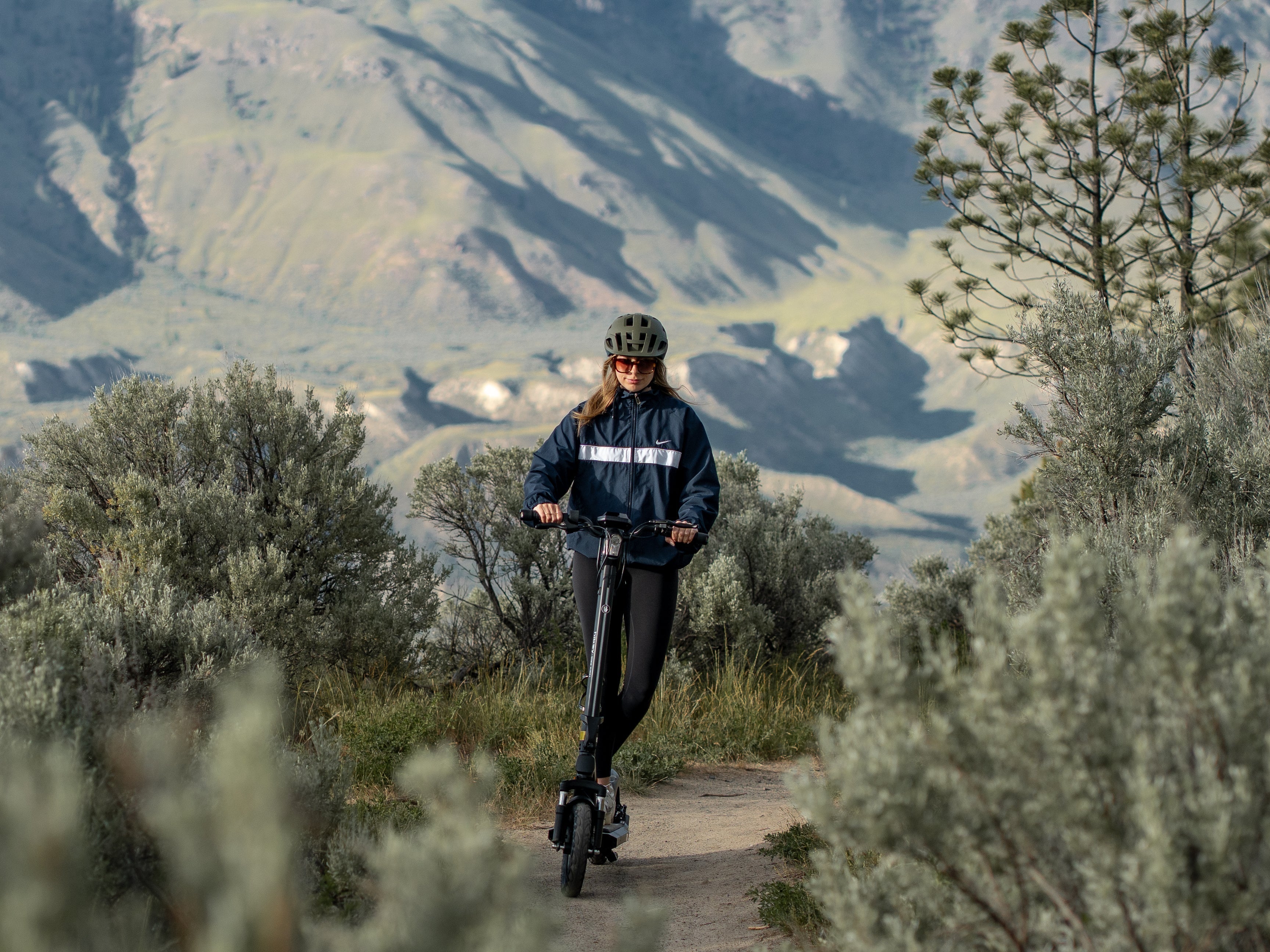
Les vastes paysages canadiens, le changement des saisons et le mode de vie mixte urbain-extérieur rendent les trottinettes électriques tout-terrain de plus en plus attrayantes. Des sentiers de gravier aux chemins forestiers en passant par les routes secondaires enneigées, les trottinettes électriques tout-terrain promettent une liberté au-delà des pistes cyclables pavées, mais sont-elles réellement pratiques au Canada ?
Ce guide explique ce qu'est une trottinette électrique tout-terrain, ses performances dans les conditions canadiennes, ce qu'il faut rechercher avant d'acheter et comment rouler légalement et en toute sécurité.
Qu'est-ce qu'une trottinette électrique tout-terrain ?
Une trottinette électrique tout-terrain est conçue pour supporter les terrains inégaux, meubles ou accidentés plutôt que le trottoir lisse de la ville. Par rapport aux trottinettes de banlieue standard, les modèles tout-terrain présentent généralement :
- Des pneus pneumatiques plus grands (souvent 10" ou plus)
- Des motifs de bande de roulement profonds pour la traction
- Des systèmes de suspension (avant, arrière ou double)
- Une garde au sol plus élevée
- Des moteurs plus puissants pour les collines et les surfaces molles
Au Canada, ces caractéristiques sont plus importantes que vous ne le pensez, surtout en dehors des grands centres urbains.

Pourquoi les trottinettes tout-terrain sont logiques au Canada
1. Terrains diversifiés
Les cyclistes canadiens rencontrent souvent :
- Des chemins de gravier et des sentiers de parc
- Des chaussées brisées après les cycles de gel-dégel hivernaux
- Des chemins de chalet et des routes secondaires non pavées
- De la neige, de la gadoue et des feuilles mouillées pendant les saisons intermédiaires
Les trottinettes tout-terrain sont conçues pour rester stables là où les trottinettes de banlieue peinent.
2. Meilleures performances en côte
De nombreuses villes canadiennes, comme Vancouver, Calgary et Québec, ont des pentes raides. Les trottinettes tout-terrain offrent généralement :
- Des moteurs à couple plus élevé
- Une meilleure traction sous charge
- Plus de confiance dans les montées
Cela les rend adaptées aux cyclistes plus lourds ou aux trajets avec équipement.

3. Polyvalence toutes saisons (avec des limites)
Bien qu'aucune trottinette électrique ne soit idéale pour l'hiver profond, les modèles tout-terrain fonctionnent mieux dans :
- La neige légère
- Les sentiers humides ou boueux
- Les températures froides qui réduisent l'efficacité de la batterie
Avec un entretien approprié, elles prolongent votre saison de conduite jusqu'au printemps et à l'automne.
Principales caractéristiques à rechercher dans une trottinette électrique tout-terrain canadienne
1. Pneus : Votre composant le plus important
- Les pneus pneumatiques absorbent les chocs et améliorent l'adhérence
- Les pneus plus larges gèrent mieux le gravier et la terre
- La bande de roulement agressive aide sur les terrains humides ou meubles
Les routes canadiennes peuvent être imprévisibles ; les pneus font ou défont la conduite.
2. Système de suspension
Les trottinettes tout-terrain bénéficient de :
- Une suspension avant pour le bruit des sentiers
- Une suspension arrière ou double pour le confort du cycliste
- Une réduction des vibrations sur les longues distances
Ceci est important sur les chemins forestiers, l'asphalte fissuré et les routes rurales.

3. Puissance et couple du moteur
Ne vous contentez pas de la vitesse maximale. Pour la conduite tout-terrain au Canada, le couple est plus important que les km/h.
- Les moteurs de 500 W et plus gèrent mieux les collines et les surfaces molles
- Une puissance de pointe plus élevée est utile au démarrage sur du gravier ou de la boue
4. Capacité de la batterie et performances par temps froid
Les températures froides réduisent l'efficacité des batteries au lithium de 20 à 30 %.
Choisissez :
- Une plus grande capacité de batterie pour une autonomie réelle plus longue
- Un stockage de la batterie à l'intérieur, si possible
- Des trottinettes conçues pour les climats variables
5. Système de freinage
Un freinage fiable est essentiel sur les sentiers en descente.
- Les freins à disque (mécaniques ou hydrauliques) sont fortement recommandés
- Les freins doubles améliorent la sécurité sur les terrains inégaux
Les trottinettes électriques tout-terrain sont-elles légales au Canada ?

Les lois sur les trottinettes électriques au Canada varient selon la province et la municipalité, mais la plupart suivent des principes similaires :
Lignes directrices générales canadiennes
- Les vitesses maximales sont souvent plafonnées à 20-24 km/h
- Le port du casque est courant, surtout pour les mineurs
- L'utilisation est limitée aux pistes cyclables, aux routes ou aux chemins désignés
- Utilisation hors route autorisée sur propriété privée ou sentiers autorisés
⚠️ Important : Les trottinettes tout-terrain de grande puissance peuvent ne pas être légales sur la voie publique dans toutes les régions. Vérifiez toujours les règlements locaux avant de rouler sur les routes ou sentiers publics.
Trottinettes tout-terrain vs vélos à pneus larges : lequel est le meilleur pour la conduite tout-terrain au Canada ?
Le terrain varié du Canada, allant des sentiers forestiers et des parcs de gravier aux rues urbaines inégales et aux promenades côtières, rend les trottinettes tout-terrain et les vélos électriques à pneus larges attrayants. Mais ces deux machines répondent à des besoins et des publics différents.

Vous trouverez ci-dessous une comparaison détaillée, côte à côte, pour vous aider à choisir.
| Caractéristique | Trottinette électrique tout-terrain | Vélo électrique à pneus larges |
| Capacité de terrain | Bonne sur sentiers légers, gravier, terre | Excellente sur gravier, neige, sable, boue |
| Autonomie | ~15–40 km | ~40–100+ km |
| Confort | Modéré (position trottinette) | Élevé (assis avec de plus gros pneus) |
| Vitesse | Jusqu'à ~25–35 km/h* | Jusqu'à ~32–45 km/h* |
| Assistance au pédalage | ❌ Non | ✅ Oui |
| Capacité de chargement | Faible | Élevée (porte-bagages/sacoches) |
| Niveau de forme physique | Faible | Modéré (selon le niveau d'assistance) |
| Portabilité | Moyenne — plus légère que les vélos électriques | Lourde — plus difficile à transporter ou à ranger |
| Coût | Généralement plus bas | Plus élevé |
| Complexité réglementaire (Canada) | Modérée (dépend de la municipalité) | Modérée* (les lois sur les vélos électriques varient selon la province) |
*Les limites de vitesse et les classifications légales varient selon les régions du Canada ; vérifiez toujours les règles locales.

1. Performance sur terrain
🛴 Trottinette électrique tout-terrain
- Idéale pour les sentiers légers, les chemins de terre et le gravier
- Plateforme petite et position basse permettant de déplacer son poids avec les pieds
- Bonne pour les courtes balades récréatives ou les sentiers de banlieue
🚲 Vélo électrique à pneus larges
- Pneus plus larges de 4 pouces et plus qui flottent sur les surfaces meubles
- Une forte assistance au pédalage aide à monter les collines et à maintenir la vitesse
- Excellent pour les excursions tout-terrain plus longues et plus accidentées (balades en forêt, neige, sable)
👉 Vainqueur (Terrain) : Vélo électrique à pneus larges — plus stable et polyvalent sur des surfaces variées.

2. Confort et expérience de conduite
🛴 Trottinette électrique tout-terrain
- Position de conduite debout
- La suspension aide, mais la fatigue peut s'accumuler sur les longs trajets
- Idéale pour les courtes distances et les excursions rapides
🚲 Vélo électrique à pneus larges
- La position assise réduit la fatigue
- Les gros pneus et la position assise absorbent mieux les chocs
- Idéal pour les longues balades, le transport de charges et les voyages
👉 Vainqueur (Confort) : Vélo électrique à pneus larges — surtout pour les longues distances.

3. Autonomie et endurance
🛴 Trottinette
- Autonomie typique de la batterie : ~15–40 km
- L'autonomie diminue sur terrain accidenté ou par temps froid
- Idéale pour les courtes sorties tout-terrain quotidiennes
🚲 Vélo électrique à pneus larges
- Les batteries de plus grande capacité supportent ~40–100+ km
- L'assistance au pédalage prolonge considérablement l'autonomie
- Meilleur choix pour les excursions d'une journée ou les sentiers isolés
👉 Vainqueur (Autonomie) : Vélo électrique à pneus larges

4. Vitesse et réglementations
🛴 Trottinette tout-terrain
- Vitesse maximale souvent ~25–35 km/h en tout-terrain
- La vitesse en ville/sur route peut être limitée par les règles locales
- Facile à enfourcher et à conduire
🚲 Vélo électrique à pneus larges
- La vitesse maximale assistée peut dépasser les limites légales selon la catégorie
- L'assistance au pédalage varie selon la classification (Classe 1/2/3)
- Les lois diffèrent selon les provinces (Î.-P.-É. vs Ontario vs C.-B.)
👉 Vainqueur (Facilité de conformité) : Trottinette — statut juridique plus simple dans certaines régions, mais toujours vérifier les règlements locaux.

5. Charge, emballage et utilisation pratique
🛴 Trottinette
- Limitée à un petit sac à dos
- Pas idéale pour les courses, le matériel ou le transport de charges
🚲 Vélo électrique
- Porte-bagages arrière et sacoches standard
- Le levage lourd, l'équipement de plein air et le matériel de camping deviennent pratiques
- Excellent pour les courses, les voyages et l'aventure
👉 Vainqueur (Utilitaire) : Vélo électrique à pneus larges

6. Condition physique et santé
🛴 Trottinette
- Faible exigence physique
- Idéale pour la mobilité sans effort
🚲 Vélo électrique
- L'assistance au pédalage vous permet de bouger avec effort
- Aide à la forme physique sans surmenage
👉 Vainqueur (Opportunité de remise en forme) : Vélo électrique à pneus larges

7. Portabilité et rangement
🛴 Trottinette
- Généralement plus légère et plus compacte
- Plus facile à ranger dans un couloir, un appartement ou un véhicule
- Peut être pliée sur de nombreux modèles
🚲 Vélo électrique
- Plus encombrante et plus lourde
- Plus difficile à monter les escaliers ou à ranger à l'intérieur
- Options pliables limitées
👉 Vainqueur (Portabilité) : Trottinette tout-terrain

8. Coût et entretien
🛴 Trottinette
- Coût initial plus faible
- Moins de pièces mobiles
- Entretien plus simple
🚲 Vélo électrique
- Prix initial plus élevé
- Plus de composants à entretenir (chaîne, dérailleur, moteur)
- Coût des pièces plus élevé
👉 Vainqueur (Coût) : Trottinette tout-terrain

Alors, lequel vous convient le mieux au Canada ?
🛴 Choisissez une trottinette électrique tout-terrain si :
- Vos trajets sont courts ou modérés
- Vous voulez une machine portable et facile à utiliser
- Les sentiers sont légers ou des chemins multi-usages
- L'espace de rangement est limité
- Vous préférez un entretien facile et un coût plus bas
🚲 Choisissez un vélo électrique à pneus larges si :
- Vous voulez une autonomie plus longue et plus de confort
- Vous roulez fréquemment sur des terrains difficiles
- Vous transportez des marchandises, de l'équipement ou explorez des sentiers éloignés
- La forme physique ou l'assistance au pédalage vous importe
- Vous voulez une machine d'extérieur plus polyvalente
Conclusion finale
Les trottinettes électriques tout-terrain et les vélos électriques à pneus larges ont tous deux leur place dans le mode de vie extérieur canadien.

- Les trottinettes offrent plaisir, commodité et une empreinte plus légère.
- Les vélos électriques à pneus larges permettent des aventures plus longues, des charges plus importantes et une exploration plus profonde.
Votre choix dépend de l'endroit où vous roulez, de la distance que vous parcourez et de ce que vous transportez.
Conseils de conduite pour les conditions canadiennes
- Évitez la neige profonde et la glace ; la traction est limitée
- Diminuez légèrement la pression des pneus pour le gravier (dans les limites de sécurité)
- Nettoyez et séchez votre trottinette après les trajets humides
- Rangez la batterie à l'intérieur pendant l'hiver
- Réduisez la vitesse sur les feuilles mouillées et la boue
Verdict final : Les trottinettes électriques tout-terrain en valent-elles la peine au Canada ?
Pour les cyclistes canadiens qui vont au-delà des rues lisses de la ville, les trottinettes électriques tout-terrain en valent absolument la peine. Elles offrent une meilleure traction, un meilleur confort et une plus grande confiance sur les terrains mixtes courants à travers le pays.
Bien qu'elles nécessitent plus d'espace de stockage et une attention particulière aux réglementations locales, leur polyvalence en fait une excellente option pour les cyclistes qui apprécient la liberté, la stabilité et l'aventure.






Partager:
Les vélos électriques à pneus larges sont-ils adaptés aux trajets quotidiens ? Avantages, inconvénients et cas d'utilisation concrets.
Roulez plus longtemps, roulez plus intelligemment : Conseils d’entretien de votre vélo électrique pour le climat canadien