



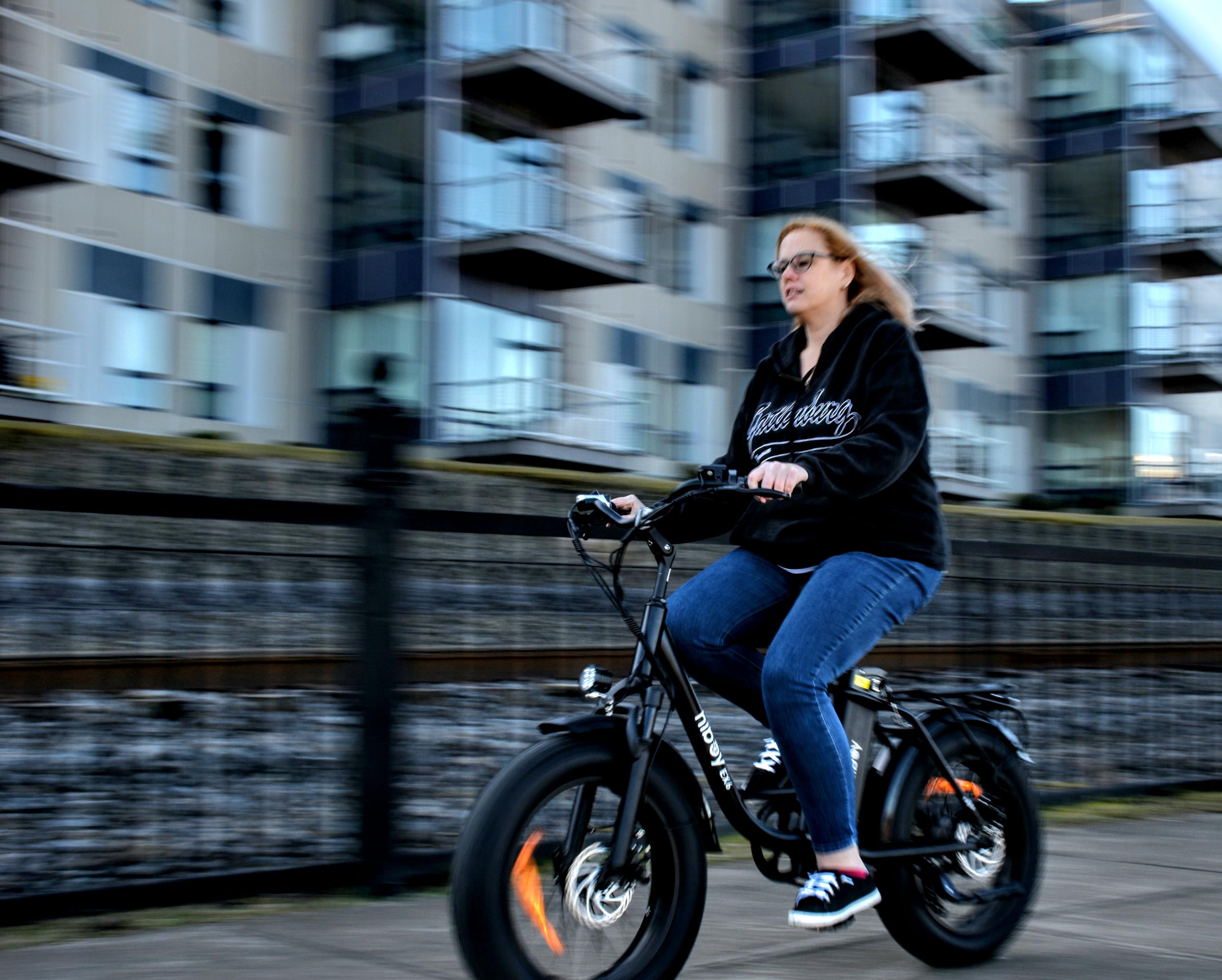
Lorsque les gens pensent aux vélos électriques de banlieue, ils imaginent souvent des pneus minces, des cadres légers et des rues urbaines lisses. Mais au Canada, le trajet domicile-travail n'est pas toujours aussi simple.
Entre les chaussées rugueuses, les chemins de gravier, la neige, la pluie et les longues intersaisons, de nombreux cyclistes commencent à se poser une question différente :
Les vélos électriques à pneus larges sont-ils vraiment meilleurs pour les trajets quotidiens au Canada ?
La réponse courte : Oui, pour de nombreux cyclistes canadiens, ils peuvent être une excellente option pour les déplacements quotidiens, selon l'endroit et la manière dont vous roulez.
Détaillons cela.
Pourquoi les vélos électriques à pneus larges ont du sens pour les trajets quotidiens au Canada

Les vélos électriques à pneus larges utilisent généralement des pneus de 4 pouces de large, par rapport aux pneus de 1,75 à 2,5 pouces des vélos de banlieue standard. Cette seule différence modifie considérablement l'expérience de conduite, en particulier dans les conditions canadiennes.
Les routes canadiennes ne sont pas toujours parfaites
Même dans les grandes villes, les navetteurs doivent faire face à :
- Chaussées fissurées après l'hiver
- Chemins de gravier et sentiers multi-usages
- Routes boueuses ou mouillées au printemps et à l'automne
- Pistes cyclables enneigées en hiver
Les pneus larges sont conçus pour gérer exactement ces situations.
Avantages des vélos électriques à pneus larges pour les trajets quotidiens
1. Stabilité et traction supérieures
Les pneus larges offrent une surface de contact beaucoup plus grande avec le sol, ce qui signifie :
- Meilleure adhérence sur chaussée mouillée
- Plus de contrôle sur la neige et la gadoue
- Amélioration de la stabilité sur le gravier et les routes inégales
C'est un grand avantage pour les navetteurs canadiens, surtout en dehors des mois d'été.

2. Plus de confort sur les surfaces rugueuses
Le volume d'air dans les pneus larges agit comme une suspension naturelle :
- Absorbe les bosses et les fissures de la route
- Réduit les vibrations sur les trajets plus longs
- Moins de fatigue lors des trajets quotidiens
Pour les cyclistes qui parcourent 10 à 30 km par jour, le confort est vraiment important.
3. Confiance en toutes saisons
Bien qu'aucun vélo électrique ne soit complètement "à l'épreuve de l'hiver", les vélos électriques à pneus larges sont :
- Plus indulgents dans des conditions froides et glissantes
- Moins susceptibles de perdre l'adhérence de manière inattendue
- Idéal pour les cyclistes qui se déplacent toute l'année
De nombreux navetteurs canadiens choisissent les vélos électriques à pneus larges simplement parce qu'ils se sentent plus en sécurité.

4. Polyvalence au-delà du trajet quotidien
Un vélo électrique à pneus larges ne sert pas seulement à se rendre au travail :
- Déplacements quotidiens en semaine
- Balades sur sentiers ou dans les parcs le week-end
- Gestion des routes de camping, des chemins de gravier et de la neige
Pour les cyclistes qui veulent un seul vélo pour tout faire, les pneus larges sont la solution.
Inconvénients des vélos électriques à pneus larges pour les trajets quotidiens
Pour être juste, les vélos électriques à pneus larges ne conviennent pas à tout le monde.
1. Poids plus élevé
Les vélos électriques à pneus larges sont généralement plus lourds que les vélos de banlieue standard :
- Plus difficiles à transporter dans les escaliers
- Moins pratiques pour les transports en commun (bus + vélo)
- Nécessitent plus d'effort pour se déplacer sans assistance motorisée

2. Efficacité légèrement inférieure
Les pneus plus larges créent plus de résistance au roulement :
- La batterie se décharge plus rapidement à grande vitesse
- Moins efficace sur les longs trajets lisses uniquement sur chaussée
Cela dit, les moteurs modernes et les grandes batteries compensent cela.
3. Stockage plus encombrant
Les vélos électriques à pneus larges :
- Prennent plus de place à l'intérieur
- Peuvent nécessiter des porte-vélos plus larges
- Ne sont pas toujours idéaux pour les petits condos ou appartements
C'est là que les modèles pliants peuvent aider (plus d'informations ci-dessous).

Vélos électriques à pneus larges vs vélos électriques de banlieue réguliers
| Caractéristique | Vélo électrique à pneus larges | Vélo électrique de banlieue régulier |
| Largeur des pneus | 4.0” | 1.75”–2.5” |
| Stabilité | Excellente | Modérée |
| Confort | Très élevé | Bon |
| Neige et gravier | Forte | Limitée |
| Efficacité | Modérée | Élevée |
| Poids | Plus lourd | Plus léger |
| Agilité urbaine | Modérée | Excellente |
| Idéal pour | Toutes saisons, terrains mixtes | Déplacements urbains fluides |
En résumé :
- Si votre trajet est 100 % sur chaussée lisse, un vélo électrique de banlieue ordinaire peut être plus efficace.
- Si votre trajet comprend des routes accidentées, des sentiers ou des trajets hivernaux, les vélos électriques à pneus larges sont excellents.
Vélos électriques à pneus larges Hiboy pour les navetteurs canadiens
Hiboy propose deux vélos électriques à pneus larges qui répondent à différents besoins de navettage au Canada : le vélo électrique à pneus larges Hiboy P6 et le vélo électrique pliant à pneus larges Hiboy EX6F.
Hiboy P6 : Idéal pour les longs trajets, les itinéraires extérieurs et les charges plus lourdes
Le Hiboy P6 est conçu pour les cyclistes qui veulent une stabilité et des capacités de sentier maximales, sans renoncer à la praticité des trajets quotidiens.
Pourquoi il convient aux trajets quotidiens au Canada
- Pneus larges 26" × 4" pour la neige, le gravier et les chaussées rugueuses
- Batterie amovible 48V 11.6Ah pour une recharge flexible
- Jusqu'à 32 km/h d'assistance au pédalage et d'accélérateur (conforme aux normes canadiennes)
- Autonomie PAS de 80 à 100 km (idéal pour les longs trajets)
- Suspension de fourche avant avec verrouillage pour l'efficacité sur chaussée
- Freins hydrauliques doubles pour un freinage sûr par temps humide
Idéal pour
- Les cyclistes qui parcourent de plus longues distances
- Les itinéraires suburbains ou sur terrains mixtes
- Les cyclistes plus lourds ou les besoins en cargo
- Les cyclistes qui aiment aussi rouler hors route ou sur sentiers
Hiboy EX6F : Idéal pour les trajets urbains et le stockage limité
L'EX6F est un vélo électrique pliant compact à pneus larges, idéal pour les citadins qui veulent du confort sans sacrifier la commodité.
Pourquoi il convient aux villes canadiennes
- Pneus larges 20" × 4" pour la stabilité avec un encombrement réduit
- Moteur de 500W (750W en pointe) pour une forte accélération en ville
- Batterie 48V 14.5Ah avec une autonomie PAS allant jusqu'à 120 km
- Cadre à enjambement bas pour un montage facile
- Freins hydrauliques pour un arrêt en toute confiance
- Conception pliable pour les condos, les appartements et les bureaux
Idéal pour
- Les navetteurs urbains
- La vie en condo ou en appartement
- Les trajets quotidiens de courte à moyenne distance
- Les cyclistes qui apprécient le rangement facile et la portabilité

Hiboy P6 vs Hiboy EX6F : Comparaison rapide
| Caractéristique | Hiboy P6 | Hiboy EX6F |
| Taille des pneus | 26" × 4" | 20" × 4" |
| Cadre | Enjambement haut | Enjambement bas |
| Batterie | 48V 11.6Ah | 48V 14.5Ah |
| Autonomie PAS | 80–100 km | Jusqu'à 120 km |
| Orientation de conduite | Longue distance et sentiers | Urbain et facile à ranger |
Verdict final : Les vélos électriques à pneus larges sont-ils bons pour les trajets quotidiens au Canada ?
Pour de nombreux cyclistes canadiens, oui, absolument. Les vélos électriques à pneus larges offrent :
- Une meilleure traction sous la pluie et la neige
- Plus de confort sur les routes endommagées
- Une plus grande confiance toute l'année
- Une polyvalence au-delà du trajet quotidien
Si votre trajet n'est pas parfaitement fluide, ou si vous roulez à travers plusieurs saisons, un vélo électrique à pneus larges comme le Hiboy P6 ou le Hiboy EX6F peut être un choix intelligent et fiable.
La clé est de choisir le modèle qui correspond à votre distance, à votre espace de rangement et à votre environnement de conduite.






Partager:
Comment supprimer le limiteur de vitesse d'un vélo électrique (Guide Canada)
Trottinettes électriques tout-terrain : Est-ce que ça vaut le coup au Canada ?