



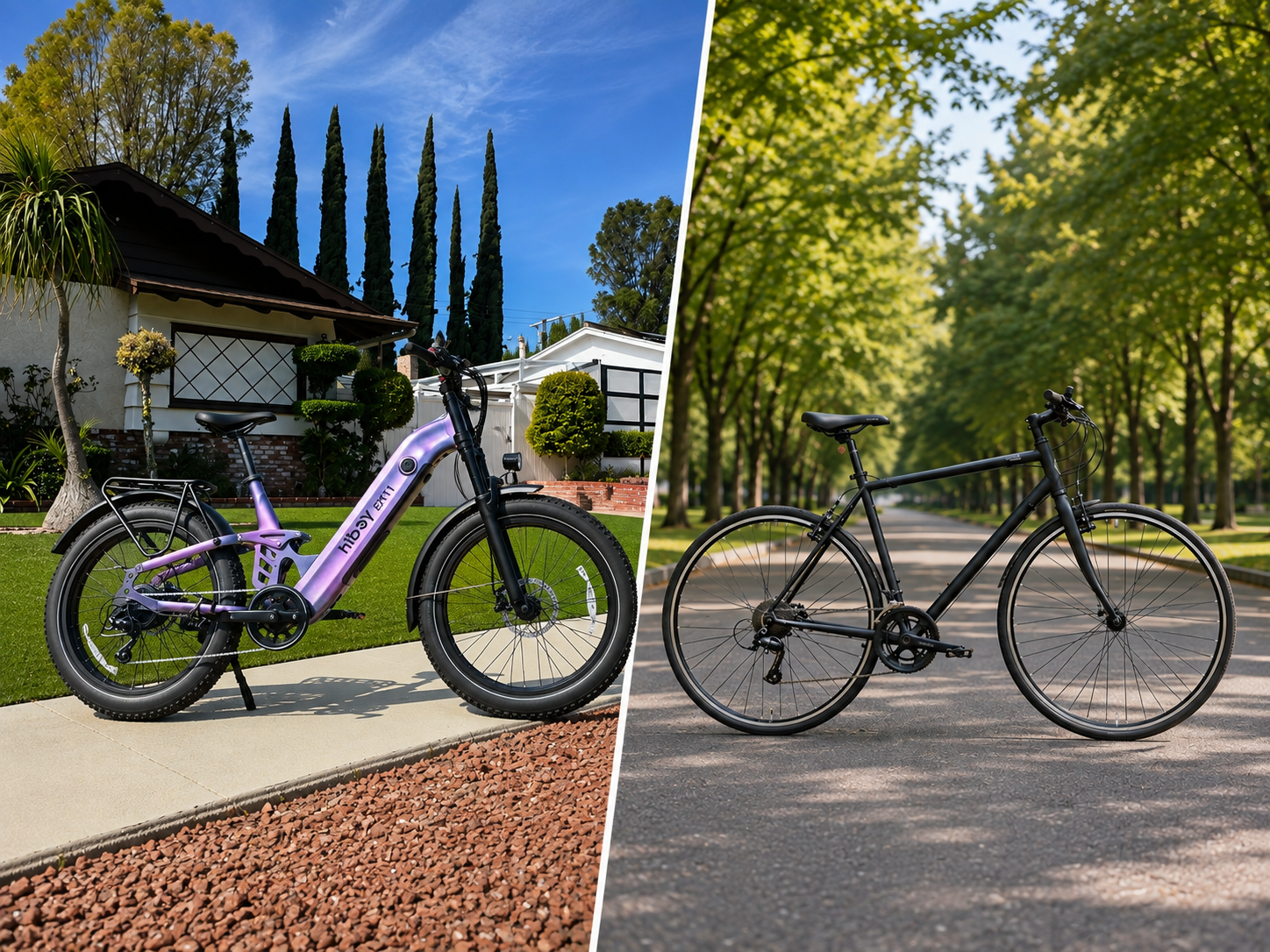
For generations, the bicycle has been one of the simplest ways to get around: no fuel, no registration, no traffic jams, and no motor required. For many riders, a traditional bike still does everything they need.
But electric bikes are changing the equation.
An e-bike adds motor assistance to the same basic cycling experience, making hills easier, extending how far many riders are willing to travel, and reducing the physical effort required to arrive at work or run errands. That extra assistance comes at a price, though and an e-bike is heavier, more expensive, and more complex than a conventional bicycle.
So, is upgrading from a traditional bike to an e-bike actually worth it?
For some riders, absolutely. For others, a traditional bike remains the better choice.
The key is not whether an e-bike is objectively "better." It is whether the additional assistance solves a problem that is preventing you from riding your current bike more often.
E-Bikes Are Becoming a Bigger Part of Canada's Cycling Landscape
The growing interest in e-bikes isn't simply a marketing trend.
Market research estimates vary considerably depending on how the market is defined, but they point in the same general direction: Canada's e-bike market is growing. Mordor Intelligence estimates the Canadian e-bike market at US$1.17 billion in 2025, with a projected increase to US$1.32 billion in 2026 and US$2.39 billion by 2031. Its 2025 analysis also estimates that pedal-assist models accounted for about 65% of the market.

There is also growing public investment in the infrastructure that makes cycling including e-bike use more practical. Canada's National Active Transportation Strategy committed $400 million over five years to support pathways, bike lanes, trails and pedestrian bridges. The federal government continues to fund active-transportation projects across the country.
And while conventional cycling remains important, the Canadian commuting data shows there is plenty of room for cycling to grow. Statistics Canada reported that nearly 139,000 Canadians commuted primarily by bicycle in 2021, while more than 811,000 used active transportation by walking or cycling. The agency noted that the pandemic and increased working from home significantly affected these numbers.
The question, then, isn't whether Canadians can ride bicycles.
It's whether an e-bike can make more people willing and able to ride more often.
E-Bike vs. Traditional Bike: The Basic Difference
At their core, both types of bicycles work the same way.
You pedal, steer, shift gears, and use brakes. The biggest difference is that an e-bike adds a battery-powered motor to assist your pedalling.
| Feature | Traditional Bike | E-Bike |
| Motor assistance | No | Yes |
| Pedalling required | Yes | Usually yes for pedal-assist models |
| Physical effort | Higher | Adjustable |
| Hill climbing | Depends heavily on rider | Motor assistance reduces effort |
| Typical weight | Lighter | Heavier |
| Purchase price | Usually lower | Usually higher |
| Maintenance | Simpler | More components |
| Range | Limited mainly by rider | Limited by rider + battery |
| Charging | Not required | Required |
| Best advantage | Simplicity and exercise | Easier, longer and more accessible rides |
Neither is inherently superior.

The better choice depends on why you ride and what prevents you from riding more.
1. Hills: One of the Biggest Reasons to Upgrade
For many riders, hills are the moment when an e-bike starts to make sense.
On a traditional bike, climbing a steep hill means increasing your physical effort, shifting to a lower gear, or slowing down.
An e-bike gives you another option: increase the level of motor assistance.
This doesn't eliminate pedalling. Instead, the motor supplements your effort.
That difference can be significant if your route includes:
- Long climbs
- Steep neighbourhood streets
- Bridges and overpasses
- Strong headwinds
- Heavy cargo
- Frequent stop-and-go riding
For example, Hiboy's Canadian e-bike lineup includes models with motors ranging from 500W to 880W, depending on the model. The P6 uses a 750W motor, while the EX6F uses a 500W motor and the EX11 uses an 880W motor.
That extra assistance doesn't mean the motor does all the work. It means the rider can choose how much work to contribute.
Traditional bike advantage
If you enjoy the physical challenge of climbing and don't mind arriving sweaty, a conventional bike may be perfectly adequate.
E-bike advantage
If hills are one of the reasons you avoid cycling, or if you want to arrive without exhausting yourself, an e-bike can fundamentally change the experience.

2. An E-Bike Can Make Longer Trips More Realistic
Distance is another major difference.
On a traditional bike, your practical range is determined largely by your fitness, route, terrain, weather and willingness to pedal.
An e-bike adds another variable: battery capacity.
The motor can help reduce the effort required per kilometre, making longer journeys more approachable.
For example, Hiboy's current Canadian lineup advertises:
These are tested under ideal conditions, not guarantees of real-world distance. Actual range will vary with rider weight, terrain, temperature, speed, assist level and other factors.
This is particularly relevant in Canada, where cold temperatures can affect battery performance.
Think about your current riding habits
If you currently ride 5–10 km because that's all the effort you want to put in, an e-bike might make 20–30 km rides feel much more manageable.
That doesn't mean you need a 160 km battery.
It means the same amount of effort can potentially take you farther.
3. E-Bikes Can Help You Ride More Consistently
This is arguably the biggest advantage and one that's easy to overlook.
The best bike for fitness isn't necessarily the bike that burns the most calories.
It's the bike you actually ride.

A 2026 systematic review published in the Journal of Physical Activity and Health examined 31 studies involving 11,890 participants. It found that e-bikes generally produced lower immediate physiological demands than conventional bicycles, but still commonly reached at least moderate intensity. Compared with no exercise, e-bike use was generally associated with greater overall physical activity and less sedentary time.
Earlier systematic reviews reached similar conclusions. A 2022 meta-analysis found that electrically assisted cycling produced lower physiological demands than conventional cycling but generally greater physiological responses than walking, with e-cycling capable of reaching moderate-intensity activity levels.
So the argument isn't:
"E-bikes are just as physically demanding as traditional bikes."
They aren't.
The more useful argument is:
An easier ride may be a ride you take more often.
If a traditional bicycle makes you think twice about a 15 km commute, a steep route, or a windy day, an e-bike may remove enough friction to turn occasional cycling into regular transportation.
4. You Still Get Exercise on an E-Bike
One common misconception is that riding an e-bike isn't really exercise.
That's too simplistic.
Pedal-assist e-bikes require the rider to pedal while the motor provides assistance. The level of effort depends on the assistance setting, terrain, speed and rider.

Research supports this distinction.
A systematic review of electrically assisted cycling found moderate evidence that e-cycling can provide at least moderate-intensity physical activity, although generally at a lower intensity than conventional cycling. It also found evidence that e-cycling could improve cardiorespiratory fitness in previously inactive individuals.
You can also adjust your effort.
On a flat road, you might use low assistance and do more of the work yourself.
On a steep hill, you might increase assistance.
On a particularly long ride, you might use more assistance early so you still have energy later.
In that sense, an e-bike can function less like a replacement for cycling and more like a customizable version of cycling.
5. Commuting: Where the Upgrade Can Really Pay Off
If you're considering an e-bike primarily for transportation, commuting is one of the strongest use cases.
Consider two hypothetical riders.
Rider A: Traditional Bike
They live 12 km from work.
The ride takes around 40–50 minutes and includes several hills. They arrive sweaty and need to change clothes before work.
As a result, they cycle only once or twice a week.
Rider B: E-Bike
The same route takes roughly the same amount of travel time, but motor assistance reduces the physical effort.
They can ride to work more frequently without arriving exhausted.
For Rider B, the e-bike may provide significantly more practical value—even though the traditional bike is cheaper.

This is why commuting distance and your tolerance for physical effort are more important than the bicycle's purchase price alone.
6. What About Canadian Weather?
This is where the decision becomes more complicated.
Canada isn't a single cycling environment.
Vancouver, Toronto, Montreal, Calgary and Halifax all have very different riding conditions.
An e-bike can help with some weather-related challenges, but it doesn't make cycling automatically suitable for every condition.
Cold temperatures
Cold weather can reduce lithium-ion battery performance and usable range.
If you're riding in winter, consider:
- Keeping the battery indoors when possible
- Avoiding charging a very cold battery immediately
- Allowing the battery to return to an appropriate temperature before charging
- Planning for reduced range in cold weather
Snow and gravel
Fat tires can provide additional stability and traction on certain loose surfaces.
Hiboy's P6, EX6, EX6F and EX11 use wide 4-inch tires, while the EX9 uses 26 × 2.5-inch tires designed more around urban riding.
However, fat tires don't make an e-bike a snowmobile. Ice, packed snow and slippery conditions still require appropriate tires, reduced speed and careful riding.
Rain
Check the manufacturer's water-resistance specifications and avoid treating water resistance as waterproofing.
Electrical components should not be unnecessarily exposed to heavy water or flooding.

7. Traditional Bikes Are Still Better in Some Ways
An e-bike isn't an automatic upgrade.
There are several situations where a traditional bike may actually be the better choice.
They're lighter
A conventional bike is generally easier to:
- Carry upstairs
- Put on a bike rack
- Lift into a vehicle
- Store
- Manoeuvre without assistance
E-bikes need to carry a motor and battery, so they are typically heavier.
For example, Hiboy's Canadian models range from approximately 64 lb for the EX9 to nearly 100 lb for the EX11, depending on the configuration.
That's a significant consideration if you live in a walk-up apartment.
They're simpler
A traditional bike doesn't have:
- A battery
- Motor
- Controller
- Charging system
- Electronic display
That means fewer electrical components to diagnose and maintain.
For riders who enjoy mechanical simplicity, this can be a major advantage.
They're cheaper to buy
You can find perfectly capable traditional bikes at prices significantly below many e-bikes.
If you mainly ride short distances on flat roads and don't struggle with physical effort, spending more on an e-bike may not provide enough additional value.
8. E-Bikes Also Cost More to Own
The purchase price is only one part of the equation.

An e-bike introduces additional components that may eventually require maintenance or replacement.
These can include:
- Battery
- Motor
- Controller
- Display
- Wiring
- Electronic sensors
That doesn't mean e-bikes are inherently unreliable.
It simply means the ownership experience is more complex.
Battery care also matters. Following the manufacturer's charging, storage and temperature recommendations can help maintain battery performance over time.
For Canadian riders, winter storage deserves particular attention.
If you won't ride for several months, don't simply leave an e-bike, and especially its battery, in an unheated garage and forget about it.
9. E-Bikes Can Make Cargo and Everyday Errands Easier
Another major advantage is that motor assistance doesn't only help with distance.
It can also help with load.
Carrying groceries, a backpack, work equipment or other cargo increases the physical effort required to ride.
Motor assistance can offset some of that additional load.
This is one reason cargo and utility e-bikes have become an important part of the broader e-bike market. Mordor Intelligence estimates that city/urban models represented 43.51% of Canadian e-bike revenue in 2025, while cargo/utility applications are projected to grow at a 13.41% CAGR through 2031.

For someone replacing short car trips with bicycle trips, this can be more important than maximum speed.
10. Which Is Better for Fitness?
This is where the answer depends heavily on your goal.
If your primary goal is maximum exercise intensity:
Traditional bike
You have to provide all the propulsion yourself, so it generally requires greater physiological effort.
If your goal is to become more physically active:
E-bike can be a very effective option
The latest systematic review found that e-bikes generally provide moderate physical activity while reducing some of the barriers associated with cycling.
If you want both:
Use an e-bike strategically.
Keep assistance low when you want more exercise.
Increase assistance when you encounter hills, strong winds, long distances or fatigue.
This approach allows you to control how much work you do.
E-Bike vs. Traditional Bike: Which One Should You Choose?
Here's a practical way to think about it.
| Your Situation | Better Choice |
| Short, flat recreational rides | Traditional bike |
| You enjoy intense exercise | Traditional bike |
| You want the lightest possible bike | Traditional bike |
| Long daily commute | E-bike |
| Frequent hills | E-bike |
| Strong headwinds | E-bike |
| Carrying groceries/cargo | E-bike |
| You want to ride more frequently | E-bike |
| You arrive at work too tired or sweaty | E-bike |
| You struggle to keep up with cycling friends | E-bike |
| You have limited storage space | Traditional bike |
| You want minimum maintenance complexity | Traditional bike |
| You want adjustable physical effort | E-bike |
Is It Worth Upgrading to an E-Bike?

For most riders, the answer comes down to one question:
What is stopping you from riding your traditional bike more often?
If the answer is:
- "The hills are too difficult."
- "My commute is too long."
- "I arrive at work exhausted."
- "I can't keep up with my riding group."
- "I want to carry groceries."
- "I don't have enough energy after work."
- "I want to ride farther."
Then an e-bike can be a meaningful upgrade.
But if your answer is:
- "I love the physical challenge."
- "I only ride short distances."
- "My routes are flat."
- "I want something lightweight."
- "I don't want to worry about charging."
Then your traditional bicycle may already be doing exactly what you need.
What to Look for When Upgrading to an E-Bike
If you've decided that an e-bike makes sense, don't simply buy the one with the biggest motor or longest advertised range.
Instead, match the bike to your actual riding.
For city commuting
Prioritize:
- Comfortable geometry
- Efficient tires
- Reliable brakes
- Practical range
- Integrated lights
- Torque sensor if you prefer natural pedal assistance

The Hiboy EX9, for example, is designed around urban commuting, with 26 × 2.5-inch tires, a 750W motor, torque sensor and advertised range of up to 100 km.
For mixed terrain
Look for:
- Wider tires
- Suspension
- Strong brakes
- Higher payload capacity
- Adequate motor output
The Hiboy P6 combines a 750W motor with 26 × 4-inch fat tires and front suspension for city streets, gravel and light trails.
For accessibility and everyday convenience
A step-through frame can make getting on and off much easier.
The Hiboy EX6 uses a step-through design, 20 × 4-inch fat tires and a 500W motor, making it particularly suited to riders who prioritize easy access and everyday practicality.
For portability
A folding e-bike can make sense if you:
- Live in a condo
- Need to store your bike indoors
- Combine cycling with public transportation
- Carry the bike in a vehicle
The Hiboy EX6F combines a folding frame with 20 × 4-inch fat tires and an advertised range of up to 120 km.

Don't Forget Canadian E-Bike Regulations
Before purchasing an e-bike, check the rules where you actually plan to ride.
E-bike definitions, power limits, speed limits, equipment requirements and where e-bikes can legally operate can vary by province and municipality.
A bike that technically has a higher maximum capability doesn't necessarily mean you can legally use that capability on every Canadian road or pathway.
Always check your provincial and local regulations before riding.
The Bottom Line: An E-Bike Isn't a Replacement for a Bicycle
The easiest way to think about the upgrade is this:
A traditional bike asks, "How much effort are you willing to put in?"
An e-bike asks, "How much effort do you want to put in today?"
That flexibility is the real advantage.
You can pedal harder when you want exercise. You can increase assistance when you encounter a hill. You can ride farther without worrying as much about fatigue. You can carry groceries without turning every trip into a workout.
And the latest research suggests that this lower barrier to cycling can matter: e-bikes generally require less physiological effort than conventional bikes, but they still provide meaningful physical activity and may help people become more active overall.
At the same time, traditional bicycles remain lighter, simpler, cheaper and more physically demanding—advantages that shouldn't be dismissed.
So, is an e-bike worth upgrading to?
If your current bicycle spends more time in the garage because the hills are too steep, the commute is too long, or you simply don't have the energy to ride as often as you'd like, that's a strong sign that an e-bike could be worth it.
If you already enjoy riding your traditional bike exactly as it is, there's no need to upgrade simply because e-bikes are becoming more popular.
The best bike isn't necessarily the one with the most technology. It's the one that makes you want to ride and keeps you riding.






Partager:
How Often Should You Service an Electric Scooter? A Maintenance Guide for Canadian Riders